Showing posts with label Georgia. Show all posts

Tuesday, November 8, 2011

OLA: 'Turning Wounds into Wisdom', Oprah


a giant Coke bottle stands as an ethereal symbol atop The World of Coca-Cola in Atlanta, Georgia
It was Oprah who once said…’turn wounds into wisdom’.  And that is what Georgia did, judging by the many great institutions it fostered out of the ravages of war, years of division, and adversity for its people. As we visited the following in Atlanta and Americus, Georgia we were greatly inspired. It was truly a different kind of sight-seeing.   
                                                                                         
Centers for Disease Control
Bill in a safe suit at Center for Disease Control
The world will forever be grateful for CDC. It was created as a US federal agency under the Department of Health and Human Services headquartered in Druid Hills, Georgia, in Greater Atlanta in 1946.  CDC works to protect public health and safety.  Successful efforts to avert two world crises, tracing contaminated poliomyelitis vaccine to a California lab in 1955 and tracking the massive influenza epidemic of 1957, positioned the agency’s future as a leader in disease surveillance.
The CDC also played a key role in one of the greatest triumphs of public health, the eradication of smallpox in 1977 through an "eradication escalation" technique.  In the mid-1970s and early 1980s, it found the cause of Legionnaires disease and toxic-shock syndrome. In 1081 CDC successfully identified the fatal disease that was subsequently named acquired immunodeficiency syndrome (AIDS). What a record in making the world a better place to live in!
Martin Luther King, Jr. National Historic Site
Martin Luther King's Tomb in the MLKJ National Historic Site
Martin Luther King, Jr. (1929–1968) is the iconic figure in the advancement of civil rights in the United States and around the world, using nonviolent methods following the teachings of Mahatma Gandhi. A Baptist minister, King led the 1955 Montgomery Bus Boycott sparked by Rosa Parks and helped found the Southern Christian Leadership Conference in 1957, serving as its first president. King's efforts led to the 1963 March on Washington, where King delivered his "I Have a Dream" speech.
 In 1964, King became the youngest person to receive the Nobel Peace Prize for his work. By the time of his death in 1968, he had refocused his efforts on ending poverty and stopping the Vietnam War. King was assassinated on April 4, 1968, in Memphis, Tennessee. The MLKJ National Historic Site in Atlanta, Georgia includes the museum, the adjacent Baptist church from which he preached, his home just a block away, and his tomb and eternal flame. The Martin Luther King, Jr. Day was established as a U.S. federal holiday in 1986. No other American is so honored, not even Washington or Lincoln.

Cola Company
Taste-It Room with over 65 flavors of Coke for free tastes!
The Coca-Cola Company is an American multinational beverage corporation. Its flagship product Coca-Cola was invented in 1886 by pharmacist John Stith Pemberton in Columbus, Georgia. Then the formula and brand were bought in 1889 by Asa Candler who incorporated The Coca-Cola Company in 1892. It now offers more than 500 brands in over 200 countries and sells over 1.6 billion servings a day! It is the world’s best known brand.
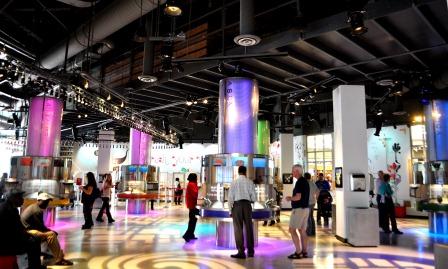
The Coca-Cola Company is headquartered in Atlanta, Georgia. And there it operates the World of Coca Cola, a complete museum with a 4D Theater featuring ‘The Secret Ingredient’, a Taste-It Room where you can taste 64 different coke flavors plus concoct your own, a Red Room with memorabilia over the years, have your picture taken with the Coke Polar Bear, a Room of Souvenirs, and a tour of the manufacturing/bottling process. It was such a fun museum for little Bill and Carol!

the CNN Center at 1 CNN Center
CNN
When I spent many a night in various hotels as part of my globe-trotting career in computers, CNN was my constant companion. I felt some excitement as I saw the familiar letters on the façade of the CNN Center in Atlanta. CNN was founded in 1980 by Ted Turner, the first to provide 24-hour television news coverage and the first all-news television channel in the United States. As of 2010, CNN is available in over 100 million U.S. households, 890,000 American hotel rooms, and 212 countries. The proliferation of news channels over the years that followed CNN is testament to the service news channels provide.
the monument at Habitat's Global Discovery Center
Habitat for Humanity/Jimmy Carter
Habitat for Humanity is an international NGO devoted to building "simple, decent, and affordable" housing, a "Christian housing ministry." Its international headquarters is located in Americus, Georgia with the administrative headquarters in Atlanta, 1,500 US satellite offices and five area offices located around the world. Its mission is to "eliminate poverty housing and homelessness from the world and to make decent shelter a matter of conscience and action."  Homes are built using volunteer labor and are sold at no profit for affordable monthly payments.
Jimmy Carter's boyhood home in Plains
I was general manager of MegaLink (the ATM consortium of banks in the Philippines) when my staff and I built a home for the Philippine Chapter of Habitat. Now, a Philippine nonprofit called Gawad Kalinga has become popular extending the Habitat vision to provide not just at cost homes but also funds and training for the establishment of livelihoods. I was inspired to see firsthand where Habitat started and to visit the nearby birthplace and boyhood home of Jimmy Carter who, at age 89, still goes on a Carter-Habitat project each year with a thousand or so volunteers to build homes.
the first Flatiron Building in America
These visits will keep Georgia in my mind…for a long, long time.
And we even found two bonuses in Atlanta. The Flat Iron Building, the city’s second skyscraper, was completed in 1897 on a wedge-shaped block, five years before New York's own version, placing it on the National Register of Historic Places. Then Margaret Mitchell ‘s home (she won the Pulitzer Prize in 1937 for Gone with the Wind, one of the most popular books of all time, selling more than 30 million copies) is very well maintained. The film adaptation of the book, released in 1939, became the highest-grossing film in the history of Hollywood, getting a record-breaking ten Academy Awards. 
Margaret Mitchell's home
Next Post: WOW: Planning Itineraries

Monday, October 31, 2011

OLA: Putting Georgia on My Mind (Attractions)


a little portion of the massive oil painting at the Cyclorama
‘Travel is fatal to prejudice, bigotry, and narrow-mindedness… Broad, wholesome, charitable views of men and things cannot be acquired by vegetating in one little corner of the earth all one's lifetime’, Mark Twain, Innocents Abroad. This quote came to my mind when Bill and I took a 2-day trip to Atlanta, Georgia, only 2 hours from our campground. Our travels finally brought us to a hotbed of the great prejudice of the past and it is a chance to confront whatever remaining prejudice, if any, we may still have
.
Stone Mountain from across the other side of the lake in the Park
 It has been a long road from the time slavery became commonplace in the American South to help landlords run their plantations. Georgia was the fifth of eleven states to secede from the Union in January 1861 on the eve of the sure election of Lincoln, an abolitionist, as president.  Today, Atlanta is still largely black, 54% in the 2010 census versus 38% white, 5% Asian, and 3% Hispanic. As we went around, I found out that this demographic and slice of history shaped the city’s top attractions.

The ‘Battle of Atlanta’ Cyclorama
the entrance facade of the Cyclorama 
Our first stop in Atlanta was the incredible Cyclorama. The painting is the largest oil painting in the world. If unrolled, it would measure 42 feet high by 358 feet long. Cheapskate Carol first thought the admission fee too high for one painting but this convinced me to temporarily abandon Budgeting 101! We viewed the cylindrical painting from the inside where we were seated on a cylinder that rotates slowly affording a 360 degree view, including the diorama which has been seamlessly built around it.

The painting brings to life the fierce fighting as Confederate defenders of Atlanta staged an unsuccessful counterattack on the Union army on July 22, 1864. Commissioned after the end of the war, it opened to display in Detroit, Michigan, in 1887, going around until the circus that owned it went bankrupt. Finally, the Atlanta Civil War Museum was built in 1921 to house it and, after a period of neglect, the painting and building were restored in the 1980s. In the end, I was glad that my frugality did not stand in the way of this unique experience! We had already missed the smaller one in Gettysburg!


the Confederate Carving bas-relief on Stone Mountain
The Stone Mountain Park
Just 45 minutes east of Atlanta is the Stone Mountain in the town of the same name. Much like Devil’s Tower in Wyoming, it is an igneous intrusion. A dome of quartz monzonite, 1,686 feet at its summit and more than five miles in circumference at its base, it has been erroneously dubbed as “the largest exposed piece of granite in the world". It is well-known not only for its geology, but also for the largest bas-relief (3 acres, 3 football fields) in the world depicting the three pillars of the Confederate States of America: Generals Stonewall Jackson and Robert E. Lee and President Jefferson Davis.

the 732-bell Carillon at Stone Mountain Park
I felt the Confederate Carving, however, fails in comparison to the grandeur of Mt. Rushmore whose very sculptor, Borglum, resigned from this project. Disappointed , we spent the time driving around the perimeter road. We were rewarded with awesome sights: the view of the mountain from the golf course across the lake, the 732-bell Carillon off a promontory into the lake (the music that was playing when we arrived was Ave Maria), the grist mill tucked away almost hidden by the blazing trees, and all the trails and winding roads with the muted fall colors of the southeast in full regalia. The Park such a neatly ‘landscaped’ piece of nature. .

And we didn’t have enough time to meander around its museums, plantations, playgrounds, and marina, camp at its campground, and dine at its hotels, all imprinted with Confederate memories.


The Underground Atlanta
Bill did business in Atlanta before. He was nostalgic about a historic downtown area of about 6 blocks where he had many a good evening of entertainment (wonder with whom?)!

Underground Atlanta today
Underground Atlanta grew from the Zero Milepost of the railroad built to connect Atlanta and Chattanooga in 1836. Many significant architectural features survived from original storefronts, including ornate marble, granite archways, cast iron pilasters, decorative brickwork, and hand-carved wood posts and panels. The construction of the MARTA rapid transit line in 1980 led to its closing.  21 years later, at a cost of $142 million, through a joint venture between the City of Atlanta and private industry, it reopened.

the stairs going down to the first level of the Underground
 It is sad that their investment has not brought back the bustling area it once probably was. Today it is largely a gathering area for African-Americans. But Bill treated me to dinner there, a fine way to end our day. He was the only Caucasian and I was the only Asian in the Georgia Peaches Restaurant at the bottom level, the entertainment level.


Andersonville National Historic Site
Andersonville National Cemetery
On our day trip to Americus, Georgia, we passed the town of Andersonville where the Confederacy had a large Civil War Prison and Cemetery. Called Camp Sumter, in existence for 14 months, the prison held 45,000 Union soldiers, almost 13,000 of whom died from disease, poor sanitation, malnutrition, overcrowding, and exposure to the elements. The largest number held at any one time was more than 32,000 in August of 1864. The National Prisoner of War Museum at the National Historic Site is dedicated to the American men and women who have suffered as POWs. The cemetery is now a National Cemetery, continuing to serve as a honored burial place for modern-day veterans.

I am so glad we travel. Little by little, we see that remaining vestiges of prejudice is being erased all around, even within, us.

Next Post: Keeping Georgia on My Mind: Great Institutions, Great Men


Tuesday, October 25, 2011

WOW: Cooking (and Eating!) in an RV


Bill likes to eat out!
The draws of campgrounds are many: activities, amenities, nearby attractions. For the Southern Trails Resort where we now are staying in Georgia, the focus is FOOD! Every Tuesday to Saturday morning we can have free all-you-can-eat fluffy pancakes for breakfast! Every Monday they rotate the following all free and all-you-can-eat treats for lunch: cheese platter and wine, sinful funnel cakes, spicy soft tacos, and fresh crisp pizzas. Every other Saturday lunch is potluck! The alternate Saturdays are free all-you-can-eat sherbet ice cream! Shared food certainly makes for a fun family atmosphere!

a Saturday lunch potluck@ Southern Trails
Challenges in RV Cooking and Eating
Thus, I am inspired and compelled to write about RV cooking and eating in this post! At 67 (Bill) and 63 (yes, we admit that we are sexygenaians), our digestive systems and metabolic rates are not quite as efficient or as high as they used to be. We are retired and, although there are a lot of fun things to do around camp, sometimes it is only food that can feed my boredom.  But we are watchful that it does not become an obsession for the consequences are, by experience and observation, usually difficult to shed!

Cooking in an RV can also be very challenging because there is naturally limited space (trust me, the microwave and oven combined in one unit can be a source of disasters and unplanned starvation!), the food supply is constantly changing (grocery outlets stock very differently across the country), and there are minimal utensils to use (you can’t really afford to keep that crepe pan, ice cream scooper, or iced tea maker!). The issues are plenty for a ‘young’ wife trying to make her man happy through his stomach! 

our spacious RV kitchen!
We have to balance healthfulness, taste, freshness, economy, convenience, and variety, all hallmark values for good nourishment.  For healthfulness, we try to reduce salt, fats, and sugar and increase fiber and manage portions. Comfort foods are increasingly becoming our favorites. However, it is quite difficult to achieve this for a couple from Kansas and the Philippines! For economy, we buy bulk to get best values but not so much as to decrease our mpg! We also watch out for farmers’ markets. So to get variety we have compiled a list of favorite dishes and divided them into two categories.

Favorite Foods
Everyday foods are those that are the easiest to prepare but are also healthy. For breakfast, our selection includes: American standards like oatmeal, cereals, grits, bagels, oatmeal cookies, oatmeal muffins, toast, banana bread, egg cups, and Filipino treats like champorado and congee.  For lunches and dinners, we choose from this list: American dishes like grilled dogs and burgers, chicken noodle soup, chicken rice, chicken n dumplings, chicken tortilla soup, chicken macaroni soup, parmesan fish, baked fish fillets, fish poached in white wine, and Filipino/Asian meals like chicken ramen soup, chicken tinola, chicken nilaga, chicken adobo, arroz caldo, Hongkong steamed fish, and fish pinangat.

our dining room...always with a view!
For company foods mean dishes for weekends, holidays, special occasions and, obviously, when we have company! Special breakfast items include hot browns, biscuits and gravy, pancakes (or waffles) and bacon, French toast, scrambled eggs or omelettes. Lunch and dinner choices are: American regulars like beef stew, pot roast, spaghetti, shepherd’s pie, roast chicken, mustard chicken, oven-baked fried chicken, roast pork, grilled pork, and pork barbeque, and Filipino/Asian selections such as bulalo, mechado, kaldereta, Hainanese chicken, chicken afritada, chicken inasal, chicken asado, and chicken teriyaki.

Side dishes for these entrees, whether every day or for company, are any of the following: baked potatoes, mashed potatoes, scalloped potatoes, whole wheat tortillas or bread, or whole corn. Of course, steamed brown rice is always available. Veggies can simply be steamed broccoli, green beans, or asparagus, succotash of green peas, carrots, and whole kernel corn, or simple romaine lettuce greens with an apple cider vinegar with honey and a little mayonnaise dressing.

You will notice that there is enough variety for a 2 ½ week menu without repetition! I have a terrible time dealing with monotony (just ask Bill!). We try to limit each meal to at most 4 ounces of meat with 1 cup of steamed rice or a medium potato or a small corn or 2 slices of bread or 2 tortillas, and as much veggies as possible per person. But when there is free food like we often do here in Southern Trails, we are invited to parties, or when we visit family and friends, we eat with mucho gusto! The sad part is that we pay for it dearly after! But soon we are able to wake up and get back to reality!

he view!
10 Commandments of RV Cooking and Eating
After 2 ½ years of RVing, we have compiled the following 10 Commandments of RV Cooking and Eating: 1) cook for two meals at a time, once left-over is ok, 2) stock up on staples to get best values but just store them in very light but air tight plastic containers, 3) buy from farmers’ markets for fresh in-season produce, 4) learn about spices (plus Better-than-Bouillon) and how they can make food taste better and different but healthy, 5) prepare everything from scratch as much as possible, 6) eat small quantities but frequently , 7) use applesauce or mashed bananas instead of butter or oil for baking, 8) boil, steam, grill, or bake only, 9) drink lots of water or non-caffeine herbal teas, and 10) have the best in ambiance, outdoors when the weather is great or with a great picture window when you have to eat inside!

Hopefully there are some ideas that you can find useful from this! And, remember, don’t ever forget to have loads of fun planning meals and hunting for ingredients, to enjoy cooking and eating with your loved one, to keep healthy and sexy, and to live long and well!

Next: Keeping Georgia on My Mind! 

Thursday, April 8, 2010

Touring Low Country USA with a Visiting Friend


Our next stops were in Low Country USA in South Carolina. What made the stays extra special, however, was the visit of my dear friend Dittas, a top-notch IT business consultant in the Philippines, who was vacationing for a month in the US.
Low Country USA is the identifier of a unique culture and geography that extends from the Sandhills of South Carolina, just east of Columbia, its capital, to its coast and outlying islands. Our campgrounds are conveniently located in the midst of beautiful Savannah, Hilton Head Island, Beaufort, Charleston, and Columbia. This area is mostly near or below sea level; thus the term "low country". As far as your eyes can see are marshes filled with low grasses and swampy water. It is perfect country for shrimping (remember Forrest Gump?).
Although Savannah is not in South Carolina, it is often included because it sits right at the border of Georgia and SC and shares much of the history, landscape and culture. It is just 45 minutes from our first campground, The Oaks at Point South. In fact, Savannah/Hilton Head International Airport was where Dittas landed and where we took her for her flight back to San Francisco. The highlight of the city is the 24 Squares around which the city was designed by Oglethorpe, the British settler in 1733, making the city one of the most organized in the world and, definitely the best structured during its time. The largest and oldest is Johnson Square but the most beautiful is Monterrey Square, especially when it is blooming with flowers on the bases of magnificent live oak trees. One of the old houses around the square is Mercer House, the site of the enchanting film, Midnight in the Garden of Good
and Evil. In another square was the park bench on which Forrest Gump sat, contemplating life like a box of chocolates (we also went to Chocolate Tree, the maker of the chocolates who gave each of us a complimentary sand dollar dark chocolate). Another enchanting section of the city is River Street where old cotton warehouses along the Savannah River had been transformed into quaint boutiques and restaurants. In fact, one of the raw bars there is where we had two dozen fresh oysters for just $6 during Happy Hour! And, on the river bank was Savannah River Queen, a paddle boat waiting for tourists to climb on board. Dittas and I could not help but be queens for an instant (beautiful queens!). At a distance, the double suspension bridge casts a striking pose in the Savannah sky. 
Hilton Head Island is an island unto itself. It was conceptualized around 1765 by Charles Fraser, a
visionary at 27. He pioneered gated communities in America as he transformed the island’s many plantations. Sea Pines is the only one open to the public for a $5 access fee and it features the South Beach (If Sea
Pines is a foot, then South Beach is its toe!) and Harbor Town. South Beach is where we had traditional fish and chips at the Salty Dog Café on the marina only to be pleasantly surprised by the best key lime pie in the whole wide world! Harbor Town, on the other hand, is where Liberty Oak, a giant centuries-old live oak, was left untouched during the development of the island and under which large, red, rocking chairs wait for visitors torelax in the beauty of the marina and its nearby shops. Elsewhere on the island are the Coligny Beach, the public beach where hundreds of colorful beach umbrellas and towels conceal the lovely tanned bodies of scantily clad men and women. On Shelter Cove stands a giant statue of Neptune whose spear tells time on one of the largest sundials in the world.   

Beaufort, SC, is the oldest of the communities, dating back from 1711. The quaint historic downtown is home to many southeastern eateries and craft shops, a beautiful waterfront, and a long and winding bridge/highway to a group of small islands the farthest of which, Fripps Island, is privately owned. We chanced upon a shrimp shack but lo and behold…all the fish and shrimps are fried! For all of us who come from the tropics, fish had better be grilled, or poached, or steamed, or baked! So we went instead to Gilligan’s Island and peeled steamed shrimps to our tummies’ satisfaction. For those who love beautiful sprawling historic homes, Beaufort is the place to be. For those who love stately more modern homes, Hilton Head Island is more ideal. And for those who care for the in-betweens, Charleston is a must.
Charleston’s beautiful southern mansions dot the road along its harbor. But the distinction of the town is in Fort Sumter. Lying just outside the city, beyond the harbor, in the middle of the water is the fort where the first blast of the Civil War began. The city is known as the Holy City with all of 300 churches around.  But the Catholic cathedral is uniquely pretty with its small, narrow facade. And the small wineries featured more of fruit wines than the regular whites and reds. But what we were thrilled about in Charleston is the City Market where hundreds of stalls, flea-market style, are laid out with so many Low Country crafts. That is where Dittas finally found a bright, flowery Welcome Sign for our RV, colorful, chunky earrings and necklace set to match an old red, yellow, orange, green, blue ring, and an off-white top made from organic cotton. As women on a frenzied shopping spree go, we were more than just satisfied with our afternoon stash!

The Oaks campground was largely uneventful (although the clubhouse was the place where I finally beat Bill in pool!) except for the 3 ponds at the back around which we took brisk walks for our afternoon exercise. There were 3 alligators there and we did not realize one of them was camouflaged as he lay lounging on the banks. Thank heavens he jumped back into the water in surprise when I asked Bill to move closer to the edge for a photo of the beautiful red, green, and yellow trees that were mirrored in the pond.
Around our campground are small towns with unique attractions. We found a Carolina Cherry (My name is actually Carolina and I have a sister named Cherry) Store where we found benne wafers (sesame seed cookies) and pecan pinches, tasty Southern snack bites. There were old church ruins in Sheldon that were almost razed to the ground by the British during the American Revolution but left elegant columns that looked like a small brick
Parthenon. We also discovered an authentic African Village (as seen on TV) where, upon entry, you are considered to have left the USA! Coosawatchie, a
town 6 miles away, was where Bill finally found a shop for the S’un (our Saturn SL1). To both our chagrin and delight, the day after Dittas left, we even discovered a Low Country Visitors’ Museum just around the corner from the camp. There Bill and I found a huge live oak with its trunk and all its branches bent to the ground. The museum also featured the ‘Blue Bottle’ tree to ward off evil spirits, a common practice in Low Country, and a joggling board, a historic contraption made by German friends of a plantation owner who had bad back problems.

Dittas treated us to lunch at a Scottish pub in downtown Savannah on the day of her departure.  We wanted to go to Paula Deen's, on the advice o a friend from Seattle, but the line was so looooong.  Bill loooooved the food (he had Guiness beef stew) and Dittas loooooved the waiter's utility kilt. The unfortunate thing was I left my purse there when we hurried to catch Dittas' flight. So the next day we had to go back one more time to Savannah and decided to hear Easter mass at the lovely
Cathedral of St. John the Baptist. On the way out of town we saw two huge cute elephants, one pink, one blue in front of a souvenir shop.
Two days after Dittas left, we headed for Big Water in Santee on Lake Marion. The campground has 2 warm pools, a Lazy River for tubing, and beach access to the lake. We spent several days of water fun. But SC fishing licenses sold for $11 for 7 days and $35 for a year so Bill postponed buying one until North Carolina where we will be staying longer, for a month and a half. The campground also gave us access to Columbia, the state capital, where we were able to finally see Avatar which was still showing in an old movie house at its outskirts! The campground was also near Sumter where we found a small flea market.  And, even if we did not find anything worthwhile buying (it was more of a large garage/junk yard sale), a good soul told us to go to the Swan Lake and Iris Gardens, the town's jewel.  That day 3 weddings were going on...it was obviously the most beautiful place around for miles.  The lake had several elegant black and white swans and the banks were filled with the spectacle of tree roots jutting out a foot or two high.  All around the lake were pedestals where buttons, when touched, would explain the tree orn plant it was beside.

Next Stops: Salisbury and Advance, NC, Lynchburg, Va, and Lenoir, NC